How Is AI Changing the Retail Business in London?
Key Takeaways
- AI-driven demand forecasting is replacing instinct-based inventory decisions for London retailers.
- Product variant tracking with batch-level precision prevents costly stock-outs and overstock situations.
- Mobile ERP integration is shifting staff from back-office admin to customer-facing roles.
- Department-specific dashboards enable real-time, exception-based management across multiple locations.
A Quiet Revolution on the High Street
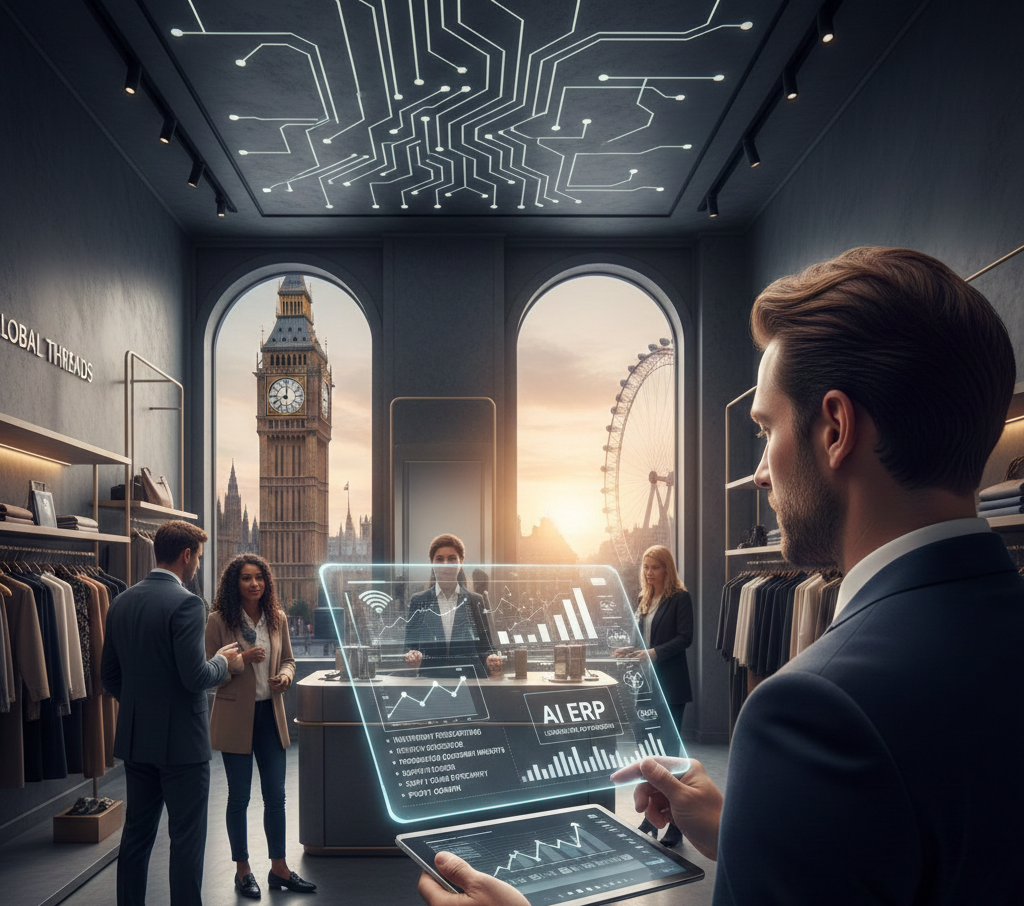
The iconic shopping districts of London, from the luxury boutiques of Bond Street to the bustling markets of Camden, are undergoing a quiet but radical transformation. Artificial intelligence is no longer a futuristic concept for the city's retailers; it has become the central nervous system of modern commerce, fundamentally altering how businesses predict trends, manage inventory, and interact with customers.
For decades, success in London's competitive high street relied on instinct and experience. Today, that intuition is being augmented by algorithmic precision. At Neptontech LTD, the prevailing analysis indicates a definitive shift across the capital: the adoption of AI is no longer about chasing innovation for its own sake, but about survival in an economy defined by speed and hyper-personalization.
Inventory Intelligence
The most immediate impact is visible in inventory management, an area where London retailers have historically struggled with the high cost of warehousing and real estate. The traditional model of stocking products based on last year's sales data has proven insufficient for a city where trends can shift overnight. AI-driven Enterprise Resource Planning (ERP) systems now allow retailers to analyze vast datasets in real time, predicting demand with granular accuracy.
This capability is particularly vital for sectors like fashion and electronics, where product variants can create logistical nightmares. Advanced systems, such as the Nepton Business Suite, enable businesses to track the same product across different batches — accounting for price variations or subtle material changes — without creating administrative chaos.
Mobilizing the Workforce
Beyond the stockroom, AI is redefining the role of the retail workforce. The day of the stationary manager glued to a back-office computer is ending. Mobile applications integrated into central ERP systems are mobilizing staff, allowing for real-time stocktaking and attendance tracking directly from the shop floor. This operational agility means employees spend less time on paperwork and more time engaging with customers, a critical advantage in a city where service quality remains a key differentiator against online giants.
From Reactive to Proactive
Data, however, remains the currency of this revolution. The sheer volume of information generated by a busy London retailer can be overwhelming without the right filters. The industry is seeing a move toward analytical dashboards that segregate data by department, offering clarity amidst the noise. For a store manager, this might mean receiving an automated notification that a specific product line is underperforming in the afternoon hours, allowing for an immediate promotional adjustment. For a financial director, it means seeing a real-time consolidation of revenue across multiple boroughs without waiting for end-of-week spreadsheets.
FAQ
Does AI replace retail staff?
No. AI automates repetitive administrative tasks, freeing staff to focus on customer service and higher-value activities. It augments human decision-making rather than replacing it.
Is AI-driven ERP only for large retailers?
Not anymore. Cloud-based platforms have made AI-powered analytics accessible to mid-sized and growing businesses, not just enterprise-level chains.
How quickly can a retailer see ROI from AI integration?
Most retailers report measurable improvements in stock accuracy and labour efficiency within the first quarter of deployment.
Conclusion
As London continues to solidify its reputation as a global tech hub, the convergence of retail tradition and digital intelligence is inevitable. The businesses that thrive will be those that view AI not as a replacement for the human touch, but as the tool that clears away operational friction, allowing them to focus on what London retailers have always done best: serving the customer.
Related Articles
Ready to Transform Your Business?
Discover how Nepton Business Suite can help you achieve your business goals.